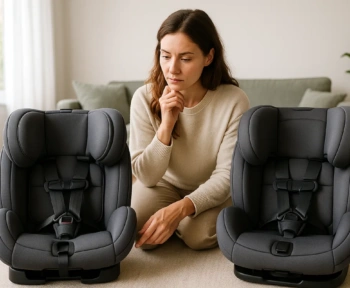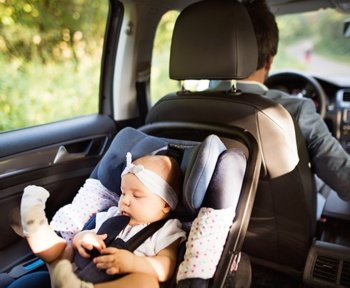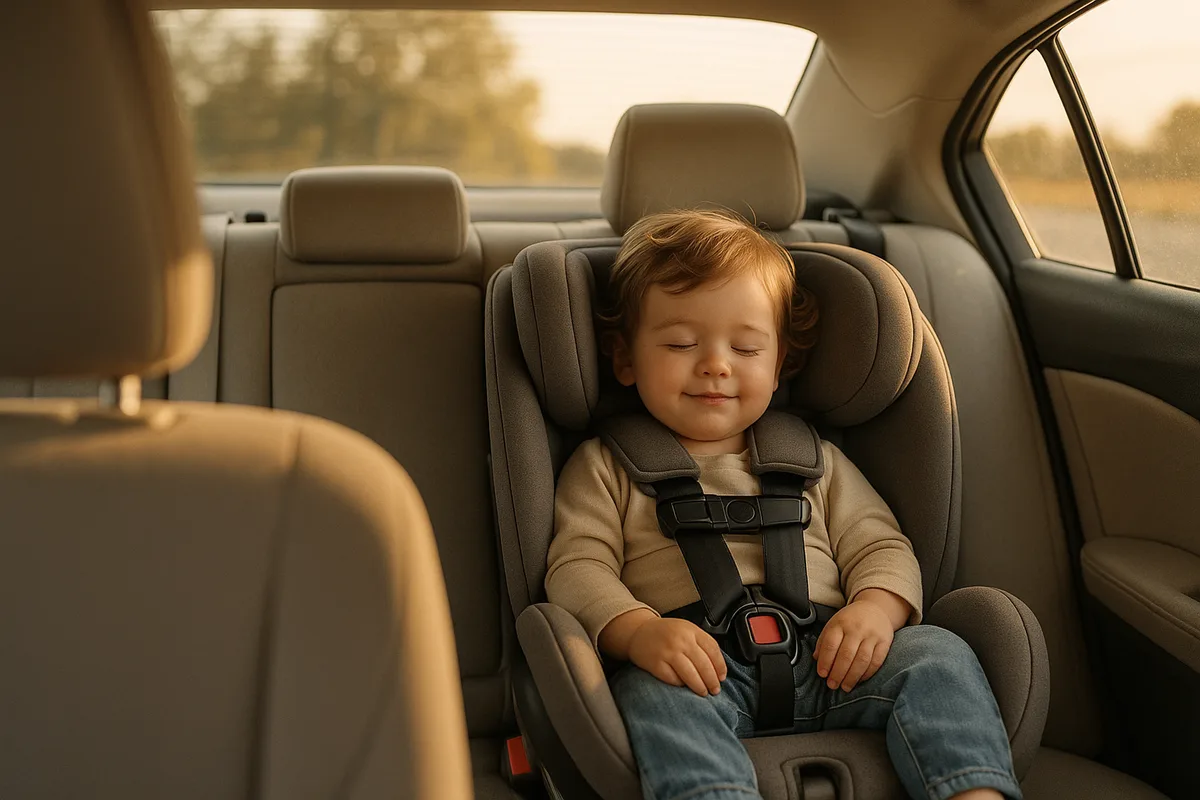
Rear-facing is five times safer than forward-facing in a frontal crash for children under two. Keep your child rear-facing until they hit the rear-facing weight or height limit of their convertible seat, typically around age 4. State laws that allow turning at age 2 are minimums, not recommendations. The AAP’s position: rear-facing as long as possible.
Why rear-facing is safer
In a frontal crash, the most common type of serious crash, the vehicle decelerates rapidly and everything inside continues forward at the original speed. Adults are restrained by the lap and shoulder belt; the belt holds the bony pelvis and chest, while the head and neck swing forward against the resistance of the neck muscles.
For a baby or toddler, the head is disproportionately heavy (about 25% of body weight, compared to about 6% in an adult), and the neck muscles are not yet strong enough to hold it. In a forward-facing crash, the head whips forward with enormous force on a fragile spine. In a rear-facing crash, the rear-facing shell catches the head, neck, and spine all at once, spreading the force across the entire back.
The 5x safer figure
A widely-cited 2007 University of Virginia analysis found rear-facing children under 2 were 75% less likely to be seriously injured or killed in a crash than forward-facing children of the same age. The IIHS and Safe Kids both summarize this and similar findings as “rear-facing is up to 5 times safer.”
Source: University of Virginia Center for Applied Biomechanics / IIHS
When can you legally turn forward?
State laws vary widely. Some allow forward-facing as early as age 1; most allow it at age 2; a handful require rear-facing through age 2 (Pennsylvania, Oklahoma, others). The full state-by-state breakdown is in our car seat laws by state guide.
Crucially: state minimum-age laws are not safety recommendations. They are a legal floor that prevents the worst cases. The American Academy of Pediatrics revised its guidance in 2018 to say children should remain rear-facing as long as the convertible seat allows, typically to age 3 or 4 with modern high-rear-facing-limit seats.
Signs your child has outgrown rear-facing
Your child has truly outgrown rear-facing when ANY of these is true on the seat in active use:
- The top of the head is within 1 inch of the top of the seat shell (the “1-inch-rule”).
- Body weight reaches the seat’s rear-facing weight cap (typically 40 to 50 pounds on a convertible).
- The harness no longer adjusts at or below the shoulders.
Notice what is NOT on the list: age, leg position, the child’s ability to ask to face forward, the parent feeling like it is “time.” The seat manufacturer sets the rear-facing limits based on crash testing of that specific shell. The limits in the seat manual are what matters.
The legs question
The most common parent worry is leg room. As toddlers grow, their legs touch the vehicle seat back. Many parents worry this is dangerous in a crash. It is not. Leg injuries in rear-facing crashes are extremely rare, and the head, neck, and spine protection of staying rear-facing far outweighs any leg-room concern.
Toddlers naturally cross their legs, rest them on the vehicle seat back, or fold them up “criss-cross applesauce.” All of those positions are fine. Read our deeper guide on toddler legs touching the seat.
Common parent worries, addressed
“My toddler hates rear-facing”
Toddler complaints are not a reason to turn forward. Most kids who initially fuss adapt within a few weeks. A new toy or book reserved for car rides, a small mirror so they can see you, or simply more frequent stops on long drives all help. The risk gap between rear- and forward-facing in a crash is too large to trade for short-term comfort.
“Forward-facing kids in my family group are fine”
Most car rides do not involve a serious crash. A forward-facing toddler is typically fine because they were not in a crash, not because forward-facing is as safe as rear-facing. Safety choices are about the worst case, not the average case.
“I cannot see my child in the mirror”
Use a small back-seat baby mirror that clips onto the headrest in front of the rear-facing seat. The mirror lets you see your child without compromising the rear-facing position. These cost roughly the same as one nice toy and are widely available.
What the seat manual actually says
Read the rear-facing limits in the seat manual that came with the convertible you actually own. Manufacturers vary: Graco’s higher-end convertibles allow rear-facing to 50 pounds; Britax allows 40 to 50 depending on model; Chicco varies by line; Diono Radian and similar narrow seats often go to 50 pounds rear-facing. The number on the box is the cap; check the height limit too, because most kids hit the height limit before the weight limit.
If you bought the seat used or it came as a hand-me-down, find the manual on the manufacturer’s website by entering the model number. Do not guess at the limits. Do not rely on a sticker that may have been worn off or replaced.
What changes when you turn the seat forward
Three things change when you transition from rear-facing to forward-facing on the same convertible seat:
- Belt path. The seat has a separate belt path for forward-facing, usually labeled red or marked with the forward-facing icon. Using the wrong belt path defeats the install.
- Recline angle. Forward-facing requires a more upright recline than rear-facing. Use the seat’s level indicator and adjust to the forward-facing zone.
- Top tether. Required forward-facing. Stowed when rear-facing. The tether anchor is in your vehicle (not the seat); locate it before you turn the seat forward.
Re-do the inch-of-movement install test after the transition. The numbers change when the seat is in a different orientation.
When forward-facing is appropriate
Once your child has truly outgrown the rear-facing limits of the seat, turn it forward-facing and continue using the 5-point harness. Most forward-facing harness seats accommodate kids to 50 or 65 pounds, which covers the average child well into elementary school. Always attach the top tether when forward-facing; it reduces forward head travel by about 6 inches in a crash per NHTSA.
Do not skip from rear-facing harness directly to a booster. The 5-point harness is meaningfully safer than a seat belt across a small body, and the harness years exist for a reason.
What the experts actually recommend
- American Academy of Pediatrics (2018): Children should remain rear-facing as long as possible, until they reach the rear-facing weight or height limit of their convertible seat.
- NHTSA: Keep children rear-facing as long as the seat allows. Most seats sold today allow rear-facing to age 3 or beyond.
- IIHS: Rear-facing is significantly safer for any child whose seat still allows it; the protection advantage scales with crash severity.
- Safe Kids Worldwide: Same guidance, with extra emphasis on tether use when forward-facing.
What none of them recommend: turning forward at the state-law minimum age, turning forward “because the legs touch,” or turning forward “because the child asked.”
After forward-facing: what comes next
When your child has outgrown the forward-facing harness limits (50 to 65 pounds depending on seat), move to a booster seat. From there, the booster years run until your child passes the 5-step seat belt fit test, typically age 10 to 12. Read our ready for booster checklist for the transition signals.
The bottom line
Stay rear-facing for as long as the convertible seat allows. The seat manual sets the rear-facing weight, height, and 1-inch-shell limits based on crash testing. State minimum-age laws are a legal floor, not a safety recommendation. Once your child truly outgrows rear-facing, turn forward-facing and continue using the 5-point harness with the top tether attached every ride.
How to Buy Yourself More Rear-Facing Time
Most families do not turn the seat forward because the child outgrew it. They turn it because the setup made rear-facing feel impossible. A few deliberate choices can add months or years to the rear-facing stage.
- Shop by the rear-facing height limit, not just weight. Most kids hit the height or shell limit long before the weight cap, so a seat with a taller rear-facing shell buys real time. Check both numbers before you buy.
- Try the seat in your actual car before committing. A rear-facing convertible needs front-to-back space. If the front passenger ends up with knees on the dashboard, you will resent the seat and be tempted to turn it early. Many stores allow a trial fit in the parking lot.
- Reposition before you give up. If the rear-facing seat does not fit behind the driver, try the center or passenger side. The center rear position often has more usable depth, and it keeps the front seats livable.
- Use the seat’s legroom features. Some convertibles include extension panels or multiple recline positions that create more leg space rear-facing. Read that section of your manual; many owners never discover these features exist.
Think of it this way: the cheapest safety upgrade available is configuring what you already own so the safer direction stays convenient.
Special Situations That Complicate the Decision
The standard advice assumes an average child in an average car. Real families hit edge cases, and these are the ones that most often push parents to turn the seat before the limits say so.
Carsickness. Some rear-facing toddlers get queasy, and parents reasonably wonder if facing forward would help. Before turning, try the usual remedies: a window view instead of a blocked one, cooler air, no screens or books in motion, light snacks before driving instead of during. Talk to your pediatrician if it persists. Motion sickness is miserable; a crash injury is worse, so treat turning forward as the last resort, not the first fix.
Three kids across one bench. Fitting a rear-facing convertible between two other seats is a puzzle, but it is usually solvable. Narrow convertibles exist for exactly this reason, and mixing up which child sits where often unlocks a combination that works. A CPST appointment is worth more than an afternoon of trial and error here.
A new baby arriving. Families sometimes turn the toddler forward to hand the convertible down to the infant. Run the numbers first: the toddler still benefits from rear-facing more than the arrangement saves you, and a second affordable convertible often beats promoting the toddler early.
Grandparents’ car. The seat in the secondary car should follow the same direction as your primary car. If the toddler rides rear-facing with you, they ride rear-facing with grandma, even if the seat in that car is older or harder to install.
Already Turned the Seat Forward? You Can Turn It Back
Plenty of parents read a guide like this one after turning the seat at age 1 or 2, then feel a quiet wave of guilt. Here is the good news: if your child is still within the seat’s rear-facing weight and height limits, you can simply turn the seat around again. There is no rule against going back, and safety advocates actively encourage it.
Expect some protest if your toddler has tasted forward-facing life. Frame it without negotiation: “This is how your seat works now.” Pair the switch with something new, a fresh window cling or a car-only toy, and hold steady for a couple of weeks while the new normal settles in. Toddlers adapt to consistent rules far faster than to wavering ones.
When you re-install, remember the changes run in reverse: move the seat back to the rear-facing belt path, set the recline back to the rear-facing zone, and stow the top tether per your manual. Then do the inch-test at the belt path again. Turning back is a small project for one afternoon, and it restores the strongest protection your seat can offer for as long as the limits allow.

Graco Extend2Fit Convertible Car Seat
- Rear-facing harness from 4 to 50 lb, forward-facing harness to 65 lb
- 4-position extension panel adds up to 5 inches of legroom for longer rear-facing
- No-rethread harness and headrest adjust together in one motion
As an Amazon Associate, topcarseats.com earns from qualifying purchases at no extra cost to you.
Common Questions Parents Ask
When can I legally turn the car seat forward?
It varies by state. Most states allow forward-facing at age 1 or 2. The legal minimum is not a safety recommendation. Read our car seat laws by state guide for the specifics.
When should I actually turn the seat forward?
When your child has truly outgrown the rear-facing limits of the convertible seat: weight cap, height cap, or the 1-inch-shell-above-head rule. Most kids on modern seats stay rear-facing until age 3 or 4.
Are my toddler’s legs at risk if they touch the seat back?
No. Leg injuries in rear-facing crashes are extremely rare. Toddlers naturally fold or cross their legs, and the head, neck, and spine protection of rear-facing far outweighs any leg-room concern.
My child screams every time we drive rear-facing. Should I turn the seat?
No. Most kids adapt within a few weeks. Try a back-seat mirror, a special toy reserved for car rides, or more frequent stops on long drives. The safety gap is too large to trade for short-term comfort.
Can I keep my child rear-facing past age 4?
Yes, if the seat allows it. Some convertibles have rear-facing weight limits up to 50 pounds, which keeps an average child rear-facing past age 4. There is no safety penalty for staying longer.
Do I need to use the top tether forward-facing?
Yes. Always. The tether reduces forward head travel in a crash by about 6 inches according to NHTSA. Skipping the tether is one of the most common forward-facing install mistakes.
Primary Sources
This article is cross-referenced against the following primary sources.
- AAP 2018 Policy Statement, Pediatric policy on rear-facing duration. aap.org
- IIHS Child Safety, Independent crash-test summary of rear vs forward. iihs.org
- NHTSA Car Seat Guidance, Federal guidance on rear-facing. nhtsa.gov
- Safe Kids Worldwide, Free CPST installation inspections. safekids.org