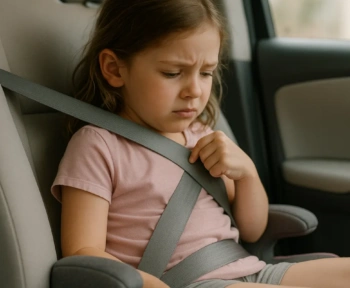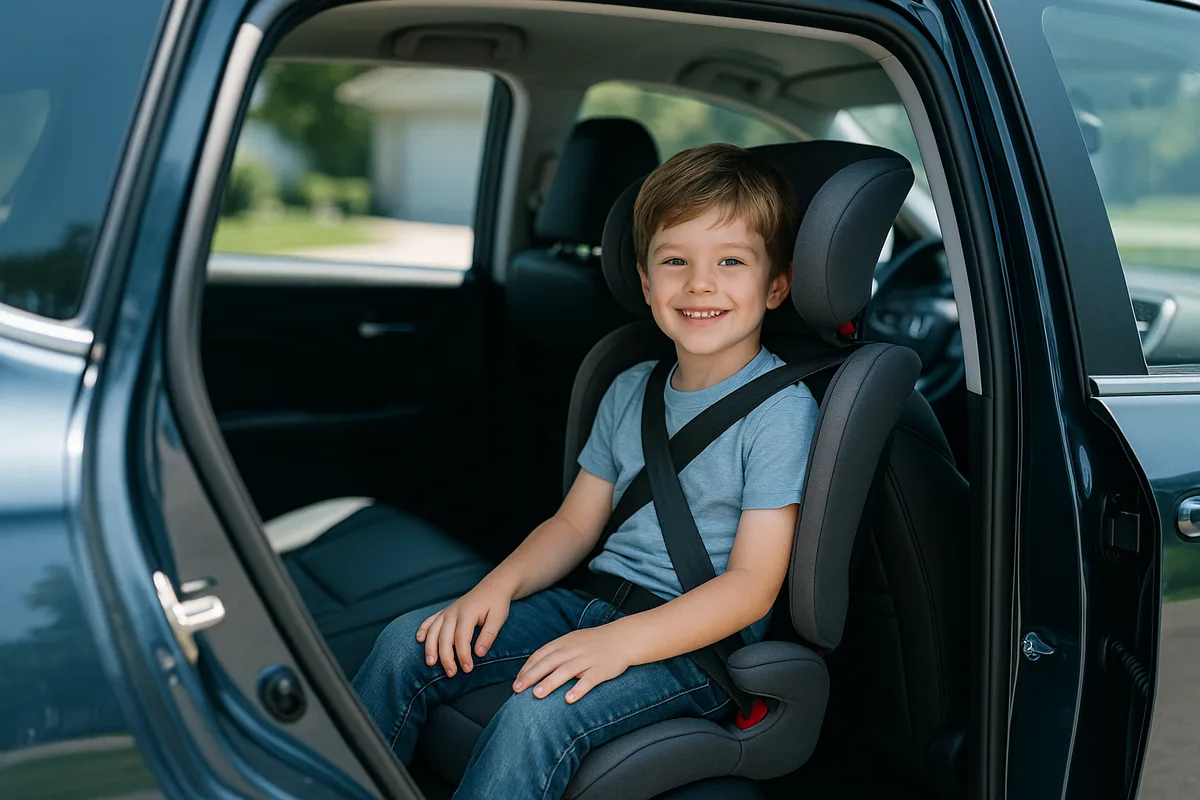
A good booster seat has a belt guide that keeps the shoulder belt on the shoulder (not the neck), a sturdy belt-positioning clip, and a back/head support when the vehicle headrest is short. High-back boosters are the safer default for most vehicles; backless works only when your vehicle headrest reaches to the top of your child’s ears.
What a booster seat does
A booster seat raises your child to the height where the adult seat belt fits correctly across their body. Without a booster, the lap belt sits on the soft tissue of the abdomen instead of the bony hips, and the shoulder belt crosses the neck or face instead of the chest and shoulder. In a crash, an ill-fitting seat belt can cause severe internal injuries, often called “seat belt syndrome,” which is a documented and preventable injury pattern in school-age children.
A booster does not provide its own restraint. It is a positioner. The vehicle’s seat belt does the actual work. That is why correct seat belt fit, every ride, is the entire point of a booster.
When is your child ready for a booster?
Three things have to be true before you move from a forward-facing harness to a booster:
- Your child has outgrown the forward-facing weight or height limits of their harness seat (typically 50 to 65 pounds).
- Your child can sit still for the entire ride without slumping, leaning, or unbuckling. Wiggling kids defeat the booster.
- Your child is at least 4 years old, ideally 5. Younger children rarely have the maturity to stay positioned.
If your child meets the weight cap but not the maturity test, stay in the harness longer. There is no safety penalty to keeping a 5-year-old in a harnessed seat. Read our ready for booster checklist for the full assessment.
High-back versus backless boosters
The default recommendation is a high-back booster. The high back provides side-impact protection, head support during sleep, and a guide for routing the shoulder belt at the right height. A backless booster is a flat seat cushion that raises the child but offers no side-impact protection of its own; it relies on the vehicle’s headrest to support the head and the seat belt’s natural geometry.
Use a backless booster only if your vehicle has a tall headrest behind the booster position, your child is mature enough to stay positioned without falling asleep at odd angles, and the lap and shoulder belt fit naturally without the high-back’s belt guides. We have a deeper breakdown in high-back vs backless boosters.
Combination harness-to-booster seats
A combination seat starts as a forward-facing harnessed seat and converts to a booster once your child outgrows the harness. These seats often have higher harness weight limits (up to 65 or even 90 pounds in some models) than convertibles, which lets some kids stay harnessed longer. If your child is on the smaller side and not yet mature enough for a booster at the convertible’s harness cap, a combination seat extends the harnessed years.
The trade-off is that combination seats are bulkier than dedicated boosters and harder to move between vehicles. For families with one driver and one regular vehicle, this is a non-issue. For families that share child-handoff between two homes, a lightweight dedicated booster may be more practical.
The 5-step seat belt fit test
The booster’s job is done when your child can pass the Safe Kids 5-step fit test in the vehicle. The test:
- Child sits all the way back against the seat back.
- Knees bend naturally over the front edge of the seat.
- Lap belt sits on the upper thighs, not the stomach.
- Shoulder belt crosses the center of the chest and shoulder, not the neck.
- Child can stay in this position for the entire ride.
Most kids do not pass all 5 steps until age 10 to 12. State laws often allow seat-belt-only at younger ages, but that is a legal floor, not a safety target. Read the full 5-step fit test guide.
Common booster mistakes parents make
- Skipping the booster too early. A 60-pound 6-year-old often does not pass the 5-step fit test. The fit test, not the weight, decides booster vs seat-belt-only.
- Tucking the shoulder belt behind the back. Kids do this when the shoulder belt sits too high and crosses their neck. The fix is a higher booster or an adjusted shoulder-belt guide, not a tucked belt. Behind-the-back is unsafe in any crash.
- Not buckling the booster when empty. An unrestrained backless booster becomes a projectile in a crash. Buckle the booster’s seat belt around it or stow it in the cargo area when the child is not riding.
- Using booster on a lap-only belt. Boosters require a lap-and-shoulder belt to work. Center seats with lap-only belts (some older vehicles) are not booster-compatible.
- Outgrown high-back kept in low position. If the head is above the high-back’s headrest, the booster is no longer providing side-impact head protection. Adjust the headrest up or move to a different seat.
Boosters in rideshare, taxi, and air travel
Children in rideshares (Uber, Lyft) need a booster the same way they do in a private car. Read our car seat in Uber or Lyft guide for the legal and practical specifics. Some cities have car-seat-required Uber tiers, but availability is limited.
For air travel, lap-only seat belts on commercial aircraft do not pair with most boosters, and the FAA does not certify boosters for in-flight use. Some boosters can be used on the airport-to-hotel taxi ride; few are practical to carry through an airport. See booster on an airplane for the full breakdown.
Features worth paying for
- Rigid LATCH connectors. Some high-back boosters lock into the LATCH anchors, which keeps the booster from launching forward in a crash even when unoccupied. Worth it if your vehicle has compatible anchors.
- Adjustable shoulder belt guide. The guide that routes the shoulder belt across the child’s shoulder needs to adjust to fit kids of different sizes.
- Adjustable head support height. Lets the booster grow with your child for several years.
Features that do NOT matter for safety
- Cup holders
- Brand prestige (all boosters sold legally pass FMVSS 213)
- Fabric pattern
- Foldable design (handy for travel, irrelevant to crash safety)
Booster placement in the vehicle
The center rear is statistically the safest position for a child according to NHTSA crash data, because it is farthest from any side impact. But “safest” only matters if the seat belt at the center position is a lap-and-shoulder belt; some older vehicles have lap-only belts at center, which are not booster-compatible. Check your vehicle before placing a booster at center.
If the center has only a lap belt or your child cannot reach the seat belt’s locking mechanism comfortably from the center, an outboard rear seat is fine. The fit of the seat belt across your child’s body matters more than the exact seat position.
When to graduate to seat belt only
Your child is ready to ride with just the seat belt when they pass all 5 steps of the fit test in your specific vehicle, on every ride. Many kids pass in some vehicles before others; a smaller car with shorter seats may allow seat-belt-only earlier than a larger SUV with deeper bench seats. Read when can child stop using a booster for the transition checklist.
One overlooked detail: even after they pass the fit test, kids should ride in the back seat until age 13 per AAP guidance. Front airbags are calibrated for adult mass and can cause serious injury to younger passengers in a crash.
The bottom line
The right booster does one job well: it positions your child so the adult seat belt fits across the bony hips and the center of the chest and shoulder. Choose a high-back booster by default. Move to backless only when your vehicle’s headrest and your child’s height combine to give a correct belt fit without the high back. Stay in a booster until your child passes the full 5-step fit test, regardless of state minimum-age laws.
What Booster Budget Tiers Actually Buy You
Boosters have the widest price spread of any car seat category, yet every one of them passes the same federal standard. The money does not buy more crash protection. It buys adjustability, stability, and comfort, which translate into more years of correct use before your child resists riding in it.
At the entry level you get a simple backless cushion or a basic high-back with limited height adjustment. The midrange adds taller headrest travel, better shoulder belt guides, and connectors that anchor the booster to the vehicle. Premium boosters add things like recline, deeper side wings, and plusher padding that an 8-year-old on a long drive genuinely appreciates.
| Tier | Typical package | Where it shines |
|---|---|---|
| Entry | Backless cushion or basic high-back, minimal adjustment | Carpool spares, grandparent cars, travel backup |
| Midrange | Tall adjustable high-back, solid belt guides, anchoring | The everyday booster for most families |
| Premium | Recline, deep side wings, plush long-haul comfort | Long commutes, kids who sleep in the car |
One practical framing: divide the cost by the years of use. A booster often serves a child from around age 5 until 10 or older, which makes a sturdy midrange high-back one of the better values in all of kid gear.
Bring Your Child and Your Car Into the Decision
A booster purchase has two fit problems to solve at once: the booster to the vehicle, and the seat belt to the child. You cannot judge either one from a product photo, so do a sit test before you commit, or buy from a retailer with easy returns and test at home.
- Check your buckle stalks. Some vehicles have short, stiff buckle stalks that disappear under a wide booster base. A child who cannot reach the buckle will quietly ride unbuckled or half-buckled. Have your child buckle themselves while you watch.
- Look at your seat contours. Heavily bolstered or sloped rear seats can leave a flat-bottomed booster rocking side to side. The booster should sit flat and stable before the child ever gets in.
- Test the shoulder belt path. Belt anchor positions differ between vehicles. In some cars the belt comes from far behind the shoulder and a particular booster’s guide will pull it perfectly; in others the same guide drags the belt toward the neck.
- Get your child’s opinion. Booster success depends on a kid willingly sitting correctly for years. A child who helped pick the seat fights it far less. This is the one car seat stage where their preference legitimately matters.
Buying Mistakes That Shorten a Booster’s Useful Life
Most booster regrets come from the purchase, not the product. These are the patterns worth avoiding when you buy.
- Going backless to save money on day one. Many 5-year-olds still fall asleep in the car, and a sleeping child in a backless booster flops out of the belt path. Start high-back, keep the receipt mindset, and go backless later when sleep stops being a factor.
- Buying for today’s height. A high-back with short headrest travel can be outgrown in a year or two while the child still needs boosting. Check how tall the headrest extends, not just the starting fit.
- Treating a travel booster as the everyday seat. Compact foldable boosters are brilliant for trips and carpools, but they usually trade away side wings, belt-guide quality, and comfort. Use them as the spare, not the daily.
- Forgetting the second car. If your child rides regularly in two vehicles, plan for two boosters up front. Moving one seat back and forth leads to rushed, sloppy belt routing on busy mornings.
- Ignoring washability. A booster lives through years of snacks, mud, and car sickness. A cover that zips off and survives the washing machine keeps the seat in service instead of in the trash.
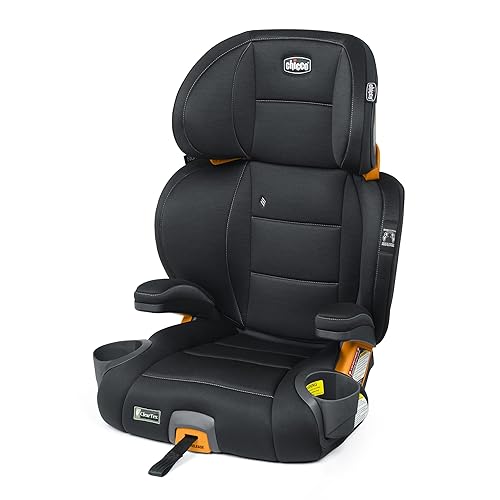
Chicco KidFit ClearTex Plus 2-in-1 Belt-Positioning Booster
- DuoGuard head and torso protection with 10-position height adjustment
- LATCH connectors with SuperCinch tightener keep the booster stable
- Flame retardant-free fabrics, removable and machine washable
As an Amazon Associate, topcarseats.com earns from qualifying purchases at no extra cost to you.
Common Questions Parents Ask
When can my child use a booster?
Once they have outgrown the forward-facing harness (typically 50 to 65 pounds), can sit reliably still for the entire ride, and are at least 4 years old, ideally 5. Maturity matters as much as size.
High-back or backless?
High-back by default. Move to backless only if your vehicle has a tall headrest, your child is mature enough to stay positioned, and the seat belt fits naturally without the high-back’s guides.
When can my child stop using a booster?
When they pass all 5 steps of the Safe Kids fit test in your specific vehicle. Most kids do not pass until age 10 to 12, even though state laws often allow seat-belt-only at younger ages.
Do I need a booster in an Uber or Lyft?
Yes. Children too small for the seat belt alone need a booster in a rideshare the same as they do in a private car. Some cities have car-seat-required Uber tiers; otherwise bring your own.
Can my child sit in the front seat once they are out of the booster?
AAP recommends back seat until age 13 even after the fit test passes. Front airbags are calibrated for adult mass and can cause serious injury to smaller passengers in a crash.
Can a booster be used on an airplane?
No. The FAA does not certify boosters for in-flight use because aircraft seat belts are lap-only. Some boosters work for airport-to-hotel taxi rides on the way.
Primary Sources
This article is cross-referenced against the following primary sources.
- Safe Kids Worldwide, Booster Guidance, CPST-body guidance on boosters. safekids.org
- AAP HealthyChildren, Boosters, Pediatric guidance on booster use. healthychildren.org
- NHTSA Booster Guidance, Federal guidance. nhtsa.gov
- IIHS Booster Research, Independent seat-belt-fit evaluations. iihs.org