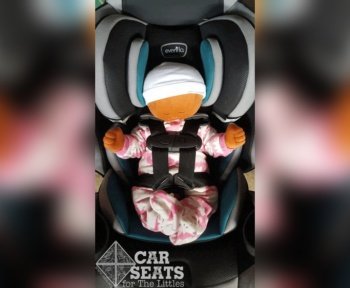
A good convertible car seat has a rear-facing weight limit of at least 40 pounds, a no-rethread harness, a clear recline adjuster, and fits your vehicle with the front seat at its normal position. A high rear-facing weight limit is the most important spec because it determines how long your child stays in the safer rear-facing position.
What a convertible car seat does
A convertible car seat is the seat that takes your child from the end of the infant-seat stage all the way to the booster years. It installs rear-facing for babies and toddlers, then converts to forward-facing once your child outgrows the rear-facing limits. Many convertibles will then also work as a high-back booster, which makes them genuinely “all-in-one” seats. The trade-off is bulk: convertibles are larger, heavier, and stay installed in the vehicle rather than clicking out like an infant seat.
Every convertible seat sold legally in the US passes the same federal crash test (FMVSS 213). The differences between models are install quality in your specific vehicle, ease of use day to day, rear-facing weight and height limits, and how comfortable the seat is for an older child who will use it for several years.
When to switch from an infant seat
Your baby is ready for a rear-facing convertible when they hit any one of three signals on the infant seat: the top of the head is within one inch of the shell, body weight reaches the seat’s rear-facing limit, or the harness no longer adjusts at or below the shoulders. Most babies hit one of these between 9 and 15 months. See our when is baby too big for infant seat guide for the full checklist.
The transition is rear-facing to rear-facing, not rear-facing to forward-facing. Even a 14-month-old who has outgrown an infant seat by height should still ride rear-facing in the convertible. The convertible’s rear-facing limit (typically 40 to 50 pounds) is what unlocks the AAP’s extended-rear-facing recommendation.
Rear-facing weight and height limits explained
Most convertibles allow rear-facing up to 40 or 50 pounds. A few go to 45 or higher. The weight limit matters less than the height limit for most kids, because most children outgrow the rear-facing height window before they reach the weight cap. The height cap is usually expressed as “1 inch of shell remaining above the top of the head,” meaning the shell needs to extend at least an inch beyond the back of the skull for crash protection.
The legs question
If your toddler’s legs touch the vehicle seat back when rear-facing, that is fine. Lower-extremity injuries are extremely rare in rear-facing crashes, and the protection to the head, neck, and spine more than offsets the leg-room concern. Read more in our toddler legs touching seat guide.
Source: AAP / Safe Kids Worldwide
Forward-facing transition
Once your child has fully outgrown the rear-facing limits of the convertible (whichever comes first: weight, height, or 1-inch-shell rule), turn the seat forward-facing. Continue using the 5-point harness; do not switch to a booster yet. Most convertible seats have a forward-facing harness limit of 50 to 65 pounds. The longer your child stays in the harness, the safer they are: the 5-point harness controls crash forces better than a seat belt across the shoulder and lap of a small body.
Always attach the top tether when forward-facing. The tether reduces forward head travel in a crash by about 6 inches according to NHTSA. Many parents skip it on convertibles because they used to have it stowed when rear-facing.
Features worth paying for
No-rethread harness
Same logic as on an infant seat: the harness adjusts up as your child grows. A no-rethread mechanism makes the adjustment a 10-second job from the front of the seat. With an older-style rethread harness, you may put off harness adjustments because they are annoying, which leaves the harness too low for too long.
Easy LATCH and seat belt access
Some convertibles have LATCH connectors that are easy to reach and lock-off plates that hold the seat belt tight; others require contorting yourself across the back seat. If you can test-fit at a baby store, do it in your specific vehicle. Install ergonomics is the difference between a 2-minute install and a 10-minute fight.
Multiple recline positions
Rear-facing requires a more reclined position than forward-facing. A seat with multiple, clearly indicated recline settings makes the rear-facing-to-forward-facing transition straightforward. Some seats use built-in foam wedges; others use a manual base lever.
3-across seating in small vehicles
If you have or are planning three children in a back seat, the seat width and how the seat installs (with what kind of belt path, with what footprint) matter as much as crash safety. Some convertibles are 17 to 18 inches wide and fit easily 3-across in a sedan. Others are 19 to 20 inches and only work 3-across in larger SUVs and minivans.
For families building a 3-across, search forums for your specific vehicle make and model plus “3 across car seat” to see what other parents have actually fit successfully. Read our breakdown of one popular option, the Diono Radian for 3-across setups.
Convertible seat lifespan
Most convertible seats expire 8 to 10 years from the manufacture date. That is enough to take one child from infant-seat graduation through booster years without buying another seat. With careful use, the same convertible can be passed down to a younger sibling. Read our guide on convertible seat lifespan for the manufacturer-by-manufacturer breakdown.
Always check the expiration date on a hand-me-down or used seat. The plastic shell can degrade enough over a decade that the seat may not perform as designed in a crash. See our broader guide on why car seats expire.
Features that do NOT matter for safety
- Brand prestige
- Cup holders
- Fabric color or premium upholstery
- Smart-connect features that pair with a phone app
- Extended warranty
Common installation pitfalls
- Wrong belt path for the install direction. Convertibles have separate belt paths for rear-facing and forward-facing, usually marked with color-coded labels. Using the wrong one defeats the seat entirely. Confirm which path you are using on every install.
- Recline angle off. Rear-facing requires a more reclined position than forward-facing. Use the seat’s bubble level or angle indicator to confirm you are in the right zone for the current direction.
- Top tether stowed. Easy to forget when transitioning a previously rear-facing seat to forward-facing. The tether anchor is usually behind the seat (on the seat back, package shelf, or cargo floor).
- LATCH at center seat. Many vehicles do NOT allow LATCH borrowing at the center position. Check your owner’s manual; if not allowed, install with the seat belt at center.
- Harness too low. Forward-facing requires the harness AT or ABOVE the shoulders; rear-facing requires AT or BELOW. After turning the seat forward, re-check the slot used.
When to move to a booster
Your child is ready for a booster seat when they have outgrown the convertible’s forward-facing harness (typically at 50 to 65 pounds), can sit reliably still for the entire ride, and are at least 4 years old. Read our ready for booster checklist before transitioning.
Some kids hit the harness weight cap at 5 or 6 but still cannot sit reliably still in a booster. There is no rush. Stay in the harness until both the size and the maturity tests pass. A combination harness-to-booster seat (with a higher harness limit, often to 65 or 90 pounds) can buy more harnessed years for kids who are physically big but not yet booster-mature.
The bottom line
The convertible seat that fits your vehicle tightly, has a no-rethread harness, and a high rear-facing weight limit will serve you for years. Test-fit at a store if you can; check forums for your specific vehicle if you cannot. Once installed, find a free CPST through Safe Kids and have the first install checked in person.
How Budget Tiers Actually Differ
Every convertible sold in the US has to pass the same federal crash standard, so a higher price does not buy a “safer crash.” What it buys is convenience, longer usable limits, and easier correct use. That last part matters, because a seat that is easier to install and adjust correctly is more likely to be used correctly every single day.
Entry-level convertibles usually give you a rethread harness, fewer recline positions, lighter padding, and a smaller shell that some kids outgrow sooner. Midrange seats typically add a no-rethread harness, clearer angle indicators, and easier LATCH hardware. Premium seats layer on plush fabrics, load legs or anti-rebound bars on some models, and smoother one-hand adjustments.
| Tier | What you typically get | Best fit for |
|---|---|---|
| Entry | Solid protection, rethread harness, fewer conveniences | Second cars, grandparents, tight budgets |
| Midrange | No-rethread harness, better recline indicators, taller shell | The everyday seat in your main vehicle |
| Premium | Comfort upgrades, easier installs, extra anti-rotation hardware on some models | Parents who move the seat often or want maximum ease |
A useful rule: spend up on the seat you touch every day, and spend down on the backup seat that lives in the second car. A correctly installed entry-level seat protects far better than a premium seat that is loose or misadjusted.
Check Your Vehicle Before You Pick the Seat
Most buyers shop by reviews first and vehicle second. Flip that order. The same convertible can install beautifully in a minivan and terribly in a compact sedan, and you cannot tell from a product page.
- Measure front-to-back space. Rear-facing convertibles need room to recline. Sit in the front seat at your normal driving position, then measure from the seat bite of the back seat to the front seatback. Deep-shell seats may force the front passenger uncomfortably forward.
- Look at your seat cushion angle. Vehicles with steeply sloped back cushions can make it hard to hit the correct rear-facing recline without pool-noodle or towel adjustments that the seat manual must permit.
- Check your head restraints. Some forward-facing convertibles need to sit flush against the vehicle seatback, and a fixed, jutting head restraint can prevent that. Find out whether yours removes or flips before buying a tall-shell seat.
- Read the LATCH section of your vehicle manual. Confirm which seating positions actually have lower anchors and where the tether anchors live. This decides which positions are realistic before you fall in love with a specific seat.
- Think about the door opening. In low-roofed cars, a tall convertible plus a tall toddler makes every buckle-in a hunched wrestle. If you load your child many times a day, this affects you more than almost any spec sheet line.
Mistakes First-Time Convertible Buyers Make
After the infant seat, the convertible purchase feels familiar, and that confidence produces a predictable set of errors. These are the ones worth avoiding.
- Buying for the baby in front of you. Your child will use this seat as a preschooler too. A seat that looks roomy around a 1-year-old but has low top harness slots can be outgrown frustratingly early. Judge the seat by its upper limits, not how cute the newborn insert is.
- Assuming one seat fits both cars. If the seat will move between vehicles, or you are buying one for each car, confirm fit in both. A seat that needs a tricky belt lock-off in your partner’s car will get installed loosely there.
- Letting fabric drive the decision. Plush covers photograph well. Harness adjusters, recline indicators, and shell height decide whether the seat is used correctly for four years.
- Buying too early and storing it. The lifespan clock starts at the manufacture date, not first use. A seat bought during a sale a year before you need it quietly spends part of its service life in a closet.
- Counting on booster mode. All-in-one marketing leans hard on the booster stage, but some convertibles make mediocre boosters with poor belt fit. Treat booster mode as a bonus, and plan to evaluate belt fit when you actually get there.

Graco Extend2Fit Convertible Car Seat
- Rear-facing harness from 4 to 50 lb, forward-facing harness to 65 lb
- 4-position extension panel adds up to 5 inches of legroom for longer rear-facing
- No-rethread harness and headrest adjust together in one motion
As an Amazon Associate, topcarseats.com earns from qualifying purchases at no extra cost to you.
Common Questions Parents Ask
Can I skip the infant seat and start with a convertible?
Yes, but most parents find an infant seat easier for the first 6 to 12 months because of the click-in stroller compatibility and ability to carry a sleeping baby. If you start with a convertible, look for one rated from 4 or 5 pounds rear-facing.
When can I turn the convertible forward?
When your child has fully outgrown the rear-facing limits: weight cap, height cap, or 1-inch-shell-above-head rule. The AAP recommends staying rear-facing as long as the seat allows, often to age 3 or 4. State minimum-age laws are not safety recommendations.
How long does a convertible seat last?
Most convertibles expire 8 to 10 years from the date of manufacture, which is stamped on the shell. Check the expiration before installing a hand-me-down or used seat.
Is LATCH or seat belt better for installing a convertible?
Either is equally safe per NHTSA when used correctly. Use whichever gives you a tighter install in your specific vehicle. Heavier kids in heavier seats may exceed LATCH weight limits and need to switch to seat belt.
My toddler’s legs touch the seat back. Is that a problem?
No. Leg injuries in rear-facing crashes are extremely rare, and the protection to the head, neck, and spine far outweighs the leg-room concern. Toddlers naturally cross their legs or rest them on the seat back.
Can the same convertible work for two kids back-to-back?
Yes, as long as the seat has not been in a crash and has not expired. Convertibles are designed for hand-down use within their lifespan. Always re-check the install when moving the seat between vehicles.
Primary Sources
This article is cross-referenced against the following primary sources.
- AAP 2018 Policy Statement, Pediatric policy on rear-facing duration. aap.org
- NHTSA Car Seats Guidance, Federal current guidance. nhtsa.gov
- IIHS Convertible Seat Research, Independent crash-test evaluations. iihs.org
- Safe Kids Worldwide, Free CPST install checks. safekids.org