Car seat safety comes down to three things: picking the right seat for your child’s age and size, installing it tightly enough that it moves less than an inch at the belt path, and keeping your child in each stage as long as possible. This guide covers every stage from newborn through seat belt graduation, with sources you can verify.
The four stages of car seat safety
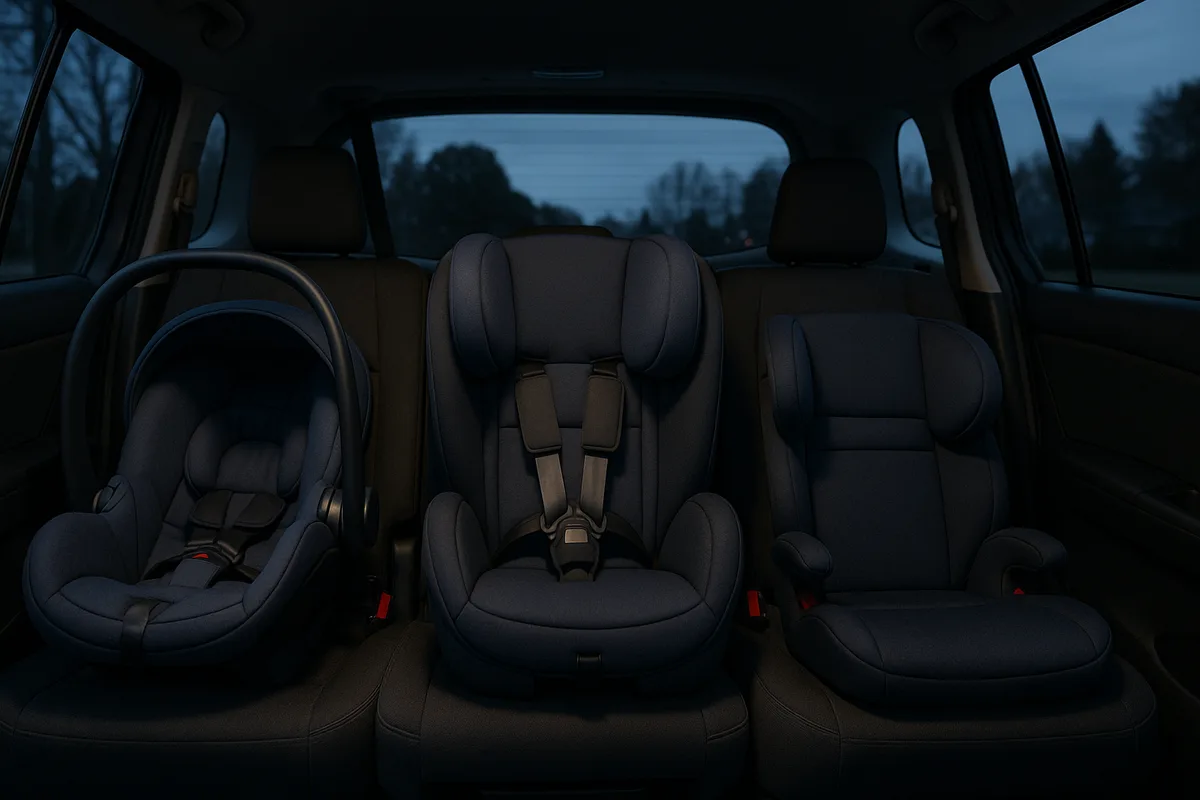
Every child moves through four distinct stages from birth through the day they ride with just a seat belt. The biggest mistake parents make is rushing these transitions. Children are safest at each stage as long as the seat allows, not until they hit the minimum age or weight to move up. The American Academy of Pediatrics revised its guidance in 2018 specifically because too many families were graduating kids early.
Here is what the research says about each stage and how to know when your child is ready for the next one.
Stage 1: Rear-facing (birth to 2+)
A rear-facing seat is five times safer than forward-facing for a child under two in a frontal crash, according to independent crash testing summarized by the IIHS. The rear-facing shell cradles the head, neck, and developing spine, spreading crash forces across the entire back instead of concentrating them on the neck.
Most babies outgrow the infant car seat by height (top of head within one inch of the shell) between 9 and 15 months. When that happens, switch to a rear-facing convertible seat. Do not turn the seat forward just because your baby had a birthday. The AAP 2018 policy statement is explicit: stay rear-facing as long as the convertible seat allows, typically up to 40 or 50 pounds. See our detailed infant seat guides for choosing a starter seat with a high rear-facing limit.
What the data shows
A widely-cited 2007 University of Virginia analysis found rear-facing children under 2 were 75% less likely to be seriously injured or killed in a crash than forward-facing children. Newer crash-test footage from Sweden, where extended rear-facing is the cultural default to age 4, repeatedly shows the dramatic difference in head excursion.
Source: University of Virginia / Swedish road traffic safety research
Stage 2: Forward-facing with a 5-point harness
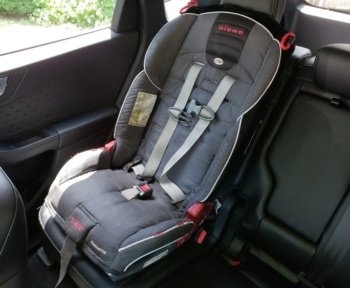
Once your child outgrows the rear-facing limits of their convertible seat, turn it forward-facing, but keep them in the 5-point harness. A harness distributes crash forces across five contact points (two shoulders, two hips, and between the legs). Most forward-facing harness seats work up to 65 pounds, which covers the average child well into elementary school.
Use the top tether every time for forward-facing installs. It anchors the top of the seat to a dedicated tether anchor in your vehicle (typically on the seat back, package shelf, or cargo floor). The tether reduces forward head travel in a crash by about 6 inches according to NHTSA, which can mean the difference between contact with the seat in front and a head injury. A surprisingly large share of forward-facing installs skip the tether entirely.
Stage 3: Booster seat
A booster seat raises your child so the adult seat belt fits correctly: lap belt low on the hips touching the upper thighs, shoulder belt crossing the center of the chest and shoulder (not the neck or face). Most kids are ready for a booster around age 5 to 7, once they have outgrown the harness and can sit still for the entire ride. Wiggling out of position defeats the booster, which is why behavior maturity matters as much as size.
We publish a detailed breakdown of high-back vs backless boosters. The short version: high-back is the safer default unless your vehicle has a tall headrest that already provides adequate side-impact protection.
Stage 4: Seat belt alone
Your child is ready for a seat belt alone when they pass the Safe Kids 5-step fit test. Age and height are not the test. Fit is. Most kids do not pass the full 5-step test until age 10 to 12, not the age 8 implied by many state laws. State minimum-age booster laws are a legal floor, not a safety recommendation.
The install test every parent should know
A correctly installed car seat moves less than one inch at the belt path, in any direction. Grab the seat at the belt path (where the seat belt or LATCH strap passes through), and pull side to side and front to back. If it shifts more than an inch, it is not tight enough. If you can swing it more than an inch from any single test, redo the install before driving anywhere.
This test works for every install method: LATCH lower anchors, seat belt, or the combination with top tether. NHTSA treats LATCH and seat belt installation as equally safe when either is used correctly. See our full breakdown of LATCH vs seat belt for which to choose in your vehicle. One thing parents miss: the LATCH weight limit. Most vehicle anchors are rated for a combined child plus seat weight of 65 pounds, which means heavier kids in heavier seats need to switch to seat belt installation.
Where in the vehicle is safest
The center rear seat is statistically the safest position for a child, according to NHTSA crash data, because it is farthest from any side impact. But “safest” only matters if you can also get a tight install in the center seat. Many vehicles have a hump, sloped center seating, or LATCH anchors that are only on the outboard positions. A tight side install beats a loose center install every time.
Never put a rear-facing seat in front of an active passenger airbag. The airbag deploys at hundreds of miles per hour and would slam into the back of the rear-facing shell. Most modern vehicles have an airbag-disable switch for the front seat, but if yours does not, the rear-facing seat must go in the back.
What most parents get wrong
- Chest clip position. The chest clip belongs at armpit level, not across the stomach. A low chest clip in a crash lets the harness slide off the shoulders. Quick check: the clip should sit between the nipples and the collarbone.
- Harness slack. After buckling, pinch the webbing at the shoulder. If you can pinch a horizontal fold, the harness is too loose. You should not be able to. The pinch test is the single most reliable harness check.
- Bulky coats. Puffy winter coats compress in a crash and leave the harness loose against the body. Dress your child in thin layers and add a blanket or coat over the buckled harness.
- Moving forward too early. Turning a toddler forward at the state-law minimum is the most common rushed transition in car seat safety. Stay rear-facing to the seat’s limit.
- Skipping the top tether. Forward-facing without the tether attached undermines the crash performance of the entire seat.
- Seat expiration. Car seats expire after 6 to 10 years, depending on model. See our guide on why car seats expire.
- After-market accessories. Strap covers, head supports, and seat protectors not made by the seat’s manufacturer are not crash-tested with the seat. They can void the certification and reduce protection.
When to get a professional inspection
Every community in the US has at least one Child Passenger Safety Technician (CPST) who will check your install for free. CPSTs complete a 32-hour training course and hold an active certification through Safe Kids Worldwide. Find your nearest inspection station through the Safe Kids car seat locator.
We recommend a CPST check after any of the following: the first install in a new vehicle, after a new baby arrives, after switching the seat between stages (rear-facing to forward, harness to booster), or any time the seat feels loose and you cannot figure out why. Even seasoned parents pick up something they had been doing wrong for years on a 20-minute CPST visit.
The short version
- Pick the right seat for the child’s current weight and height.
- Install it tightly: less than one inch of movement at the belt path.
- Use each stage as long as the seat allows. Do not rush transitions.
- Check the chest clip, harness tightness, and (forward-facing) top tether every ride.
- When in doubt, find a free CPST through Safe Kids.

Graco Extend2Fit Convertible Car Seat
- Rear-facing harness from 4 to 50 lb, forward-facing harness to 65 lb
- 4-position extension panel adds up to 5 inches of legroom for longer rear-facing
- No-rethread harness and headrest adjust together in one motion
As an Amazon Associate, topcarseats.com earns from qualifying purchases at no extra cost to you.
Common Questions Parents Ask
When can my child legally face forward?
Most state laws allow forward-facing at age 1 or 2, but legal minimums are not safety recommendations. The AAP and Safe Kids both advise keeping children rear-facing until they reach the convertible seat’s rear-facing weight or height limit, often around age 4. The seat manual is your best guide.
Is the center seat always safest?
Statistically, yes. Center rear is farthest from any side impact. But a tight install on either outboard position is safer than a loose install in the center. If your vehicle’s center seat does not allow a flat, snug fit, use the side that does.
How do I know if my install is tight enough?
Grab the car seat at the belt path (where the seat belt or LATCH strap passes through) and pull side to side and front to back. If the seat moves more than one inch in any direction, the install is not tight enough.
Do I need to use both LATCH and the seat belt?
No. Use one or the other, not both, unless your seat manual explicitly allows dual installation. Most do not. LATCH lower anchors and the seat belt are two separate, equally safe install methods.
What if my child unbuckles the chest clip?
This is common between ages 2 and 4. Try a chest clip guard (one approved by your seat’s manufacturer), explain that the car will not move until everyone is buckled, and stay consistent. If the behavior persists, ask a CPST about specific coping strategies for your seat model.
When should I replace a car seat after an accident?
NHTSA says any moderate or severe crash means replace the seat. For a minor crash (vehicle drivable, no airbag deployment, no injuries, no visible damage to the seat, no door near the seat damaged), the seat can usually be reused. Check your seat manual; some manufacturers require replacement after any crash.
Primary Sources
This article is cross-referenced against the following primary sources.
- NHTSA Car Seats & Booster Seats, Federal guidance on all four stages. nhtsa.gov
- AAP HealthyChildren, Car Seats, Parent-facing pediatric guidance. healthychildren.org
- Safe Kids Worldwide, CPST certification body; free inspection stations. safekids.org
- IIHS Child Safety, Independent crash-test and booster evaluations. iihs.org